
How We Teach Math: Multidisciplinary, Multisensory, Hands-on
Through a multidisciplinary, collaborative approach to math, BVWS students grow into skilled and confident math learners and problem solvers.
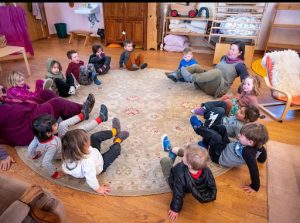
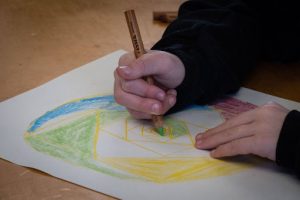
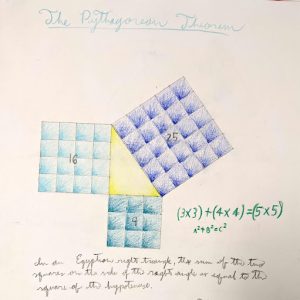
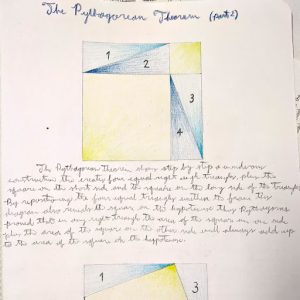
On a sunny autumn morning, 2nd graders are marching in a line along the path, counting in time and clapping on every third step. In the 4th grade classroom, pairs of students are slicing apples in half, and then in half again. Across campus, 6th graders are silently working with a compass, straightedge, and colored pencils, the classroom a space of quiet focus as they create detailed geometric drawings.
All of these students are learning math, and they are learning it in the way that research shows is most effective: through varied, multi-sensory, and collaborative experiences. At BVWS, we aim to teach children to think creatively and flexibly about numbers, to see how math works in the real world, and—perhaps most importantly—to feel confident in their ability to tackle the complex problems and conceptual challenges of math learning.
Here’s how we do it.
Multisensory Math Learning—From the Start
Young children are natural mathematical learners. Long before they ever see a worksheet, children display an innate sense of numbers and counting. Researchers have even found that toddlers can solve simple algebraic problems. At BVWS, our program is designed to nurture the young child’s intuitive understanding of math while simultaneously fostering foundational skills that prepare them for formal instruction in math.
Throughout preschool and kindergarten, teachers thoughtfully weave mathematical concepts into daily activities such as stories, art, music, movement, and play. Reciting verses and singing counting songs encourage an understanding of numbers, rhythm, and patterns. Classroom chores—like setting the table before snack time or helping measure ingredients for cooking projects—encourage basic mathematical thinking in sorting, pattern recognition, counting, and measurement. Guided movement and finger games are shown to be linked to long-term math ability, stimulating cognitive pathways and an ability to follow step-by-step instructions.
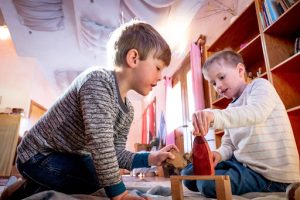
While it may not be the first thing we associate with math education, preschool and kindergarten students benefit from ample time for uninterrupted imaginative play. Play is essential in developing new neural connections in the brain. It is also how children explore and understand the world around them. Basic math concepts like comparison, weight, volume, counting, and pattern recognition naturally arise during play and everyday life. Even playing with simple wooden blocks can be key to developing spatial reasoning skills in early childhood, which are in turn linked to long-term math achievement.

Beyond STEAM
The integration of science, technology, engineering, art, and mathematics—often referred to by the acronym STEAM—has become a popular concept in contemporary education. Research in STEAM has shown that teaching these subjects together promotes creativity and critical thinking. At BVWS, we have always taken this concept a step further, teaching academic subjects in a distinctly interdisciplinary way while incorporating art, music, and movement into every academic area.
BVWS teachers incorporate activities that unite movement and math through games, rhythmical exercises, and songs, cementing foundational knowledge in the body and mind. For example, 1st graders build number sense and math facts through skip counting (“3, 6, 9, 12… 4, 8, 12, 16”) while jumping rope, tossing bean bags, or playing hand-clapping games.
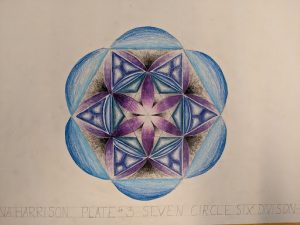
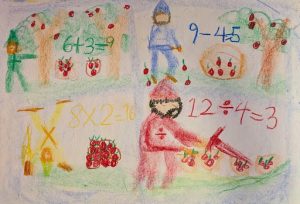
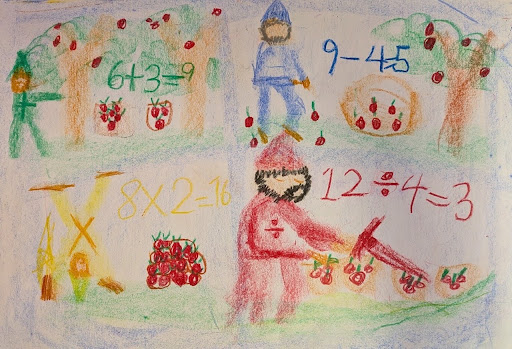
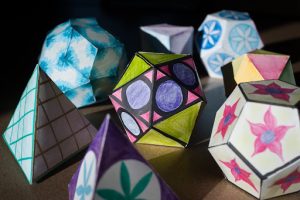
Visual arts are incorporated across academic areas at BVWS, and they are an especially effective tool in math learning, stimulating both the spatial and visual centers of the brain. In 1st grade, students may illustrate a word problem to visualize the arithmetic they’ll need to solve it. In 2nd grade, children explore number patterns by numbering the points on shapes like decagons and pentagons. When studying geometry, 8th graders create, by-hand, complex three-dimensional paper models of polygons.
Importantly, activities like art and movement require active engagement from students. “Unlike passive activities such as listening to a lecture or viewing images, drawing is an active process that requires students to reconstruct material,” write Youki Terada and Stephen Merrill in the article “The Power of Multimodal Learning” in Edutopia. Activities that fuse sensory experiences with perceptual information, they explain, lead to “durable, deeply encoded memories.” Which translates to: knowledge for life.
Learning By Doing
Baking muffins, playing a dice game, calculating a tip at a restaurant: Math learning becomes relevant to students when abstract concepts are connected to the real world. From preschool to 8th grade, a throughline in our approach to math is an emphasis on collaborative, hands-on experiences that ground classroom learning.
More than any other traditional academic discipline, math is learned by doing—but that doesn’t mean it’s all done on paper! 3rd graders might study measurements, weights, and volume in their morning math class then spend the afternoon baking a cake, putting their new skills to use. In 6th grade, the study of business math and economics is an opportunity for middle schoolers to see how math applies to real world scenarios, like developing their own businesses and considering profit, loss, sales and taxes.
Math capacities are further honed through disciplines that aren’t strictly mathematical. Research has long shown a link between music education and math achievement, and our program is rich in music, including instruction in choir, recorders, and violin. Math skills are also reinforced through crafting projects like knitting, which engages intuitive math skills like patterns, counting, spatial reasoning, and projection to complete.
Big Concepts and Confidence in Math
Becoming an effective mathematical thinker goes beyond the arithmetic we use when calculating a tip or baking a pie. At a higher level, math is an engaging conceptual discipline, which requires reasoning, resilience, and creative thinking to tackle.
BVWS students build the skills they need to excel in advanced-level mathematics, which requires conceptual understanding and self-confidence. From the earliest ages, our approach to math asks students to look at the bigger picture. For most first graders, their very first math lesson at BVWS is an exploration of the number 1 and its significance. We revisit the question of 1 during the 4th grade study of fractions, when we consider what it means to divide 1 into parts.
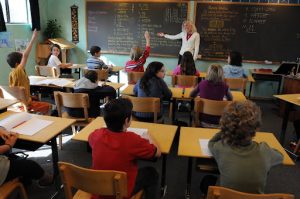
By middle school, children are capable of more complex conceptual thought, and our math curriculum expands to meet their new capacities with a challenging curriculum in geometry, pre-algebra, and algebra. While students continue to use visual tools and group work to support learning, teachers also introduce more complex mathematical problems that encourage an inquiry-based approach. We explore the history of math, tracing ideas back through time, and engage in class discussions that explore complex problems where right answers aren’t always obvious.
Importantly, as math class becomes more challenging, our teachers emphasize the importance of big-picture ideas, process, and trial and error. That’s because one of the most important skills in math learning is having a “growth mindset,” or the belief that intelligence and skills can be developed through practice. In fact, making mistakes is one of the most important experiences in learning!
Prepared for the Next Step
Math classes at BVWS are colorful, creative, and immersive. They are also effective. Our teachers don’t just make math learning engaging; they prepare students with the skills and mind-set to achieve in math and other STEM fields in high school and in life. In fact, BVWS alumni frequently test into advanced-level courses in math when starting high school, and many go into STEM fields in college and for their careers.
While our program may look different from what you’d see in a mainstream school setting, our mathematics curriculum meets all Colorado state standards, and it is overseen by a dedicated math specialist, who ensures that classes are meeting (and often exceeding!) grade-level benchmarks each year. Throughout 5th, 6th, 7th, and 8th grade, students take daily math classes with our math specialist in addition to multidisciplinary math blocks during their main lesson period, giving them a wide breadth of math experience.
Learn more about our program at https://bvwaldorf.org/