

Learning to Read, Reading to Learn: Our Approach to Literacy
At Boulder Valley Waldorf School, our approach to literacy guides students in becoming capable and confident readers and writers. More importantly, it fosters a lifelong love of reading, language, and story.
Among the internet’s opinionated literati, there is a lively debate going on: If you’ve listened to an audiobook, does it count as having “read” that book? Those who say it does may have science on their side: Cognitive research shows that the brain networks that light up for spoken and written language are surprisingly similar.
“Reading is a complex skill that involves the early development of brain regions that support sound and language processing, the essential milestone skills for learning to read,” explains Harvard Graduate School of Education professor Nadine Gaab in an interview with the Harvard Gazette. And while Gaab and other researchers agree that reading on paper engages a broader network in the brain, “The neural networks that process written and oral language are deeply intertwined and largely overlap when reading print books or listening to audiobooks.”
No matter where you fall in the audiobook debate, it reveals something we’ve long understood at Boulder Valley Waldorf School: That learning to listen and speak are intimately tied to the ability to read and write. Understanding literacy in its larger context of language and communication—and taking time to develop the cognitive skills needed to read and write effectively—is at the heart of Boulder Valley Waldorf School’s approach.
From preschool to 8th grade, our carefully sequenced and age-appropriate program guides students in becoming capable and confident readers and writers while fostering a deep and enduring love for language and story. Here’s how we do it.
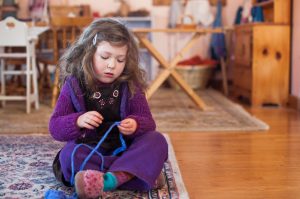

Preschool and Kindergarten: Building Essential Foundational Skills
When it comes to elementary education, there is no skill more important than learning to read and write. Studies show that the strength of a child’s literacy skills can predict their academic outcomes across disciplines; even math achievement is linked to reading proficiency. In the rush to get young children to read and write at increasingly early ages, many preschool and kindergarten programs skip over the foundational steps that make learning to read both effective and enjoyable.
By contrast, BVWS’s early childhood programs place tremendous emphasis on building foundational literacy skills, including phonemic awareness, motor skills and hand-eye coordination, auditory and language comprehension, an ability to focus, and oral communication skills, among other building blocks for literacy. One of the most important ways we do this is through a classroom rich in high-quality language. Every day in preschool and kindergarten, we sing, we recite verses, we listen to instructions from our teacher, and we listen to stories or watch live puppet shows together.
Story time, in particular, is a powerhouse of pre-literacy learning. Through stories, children pick up new words and sounds, learn to recognize a narrative arc, comprehend sophisticated sentence structure, and practice forming mental pictures, a capacity that research shows is a critical part of the path to literacy. To reinforce these skills, our teachers often tell the same story for several days—or even a full week—which helps promote recall, in addition to developing vocabulary and fluency as students revisit the story’s words and narrative. In this way, our students become sophisticated “readers” long before they begin decoding words.
Teachers further prepare their students for formal literacy instruction through complementary activities, including finger games, craft projects, and guided movements that promote dexterity, fine motor skills, and hand-eye coordination, which children need to be able to hold a pencil and form letters on a page. Learning to listen to instructions from a teacher or sit quietly during a story further prepares children to maintain focus and self-regulation, essential for young learners who need to sustain attention in class.
Perhaps most importantly, our preschool and kindergarten curriculum includes ample opportunity for children to practice their most advanced language skills in free, imaginative play. Not only does play give children an arena in which to practice speaking and listening, play encourages students to experience stories and language. Our students often invent story-games while playing together, and even act out a puppet show or story that they’ve previously heard from their teachers, demonstrating a growing understanding of narratives and stories.
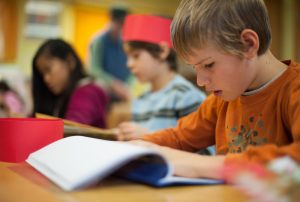
Elementary School: Structured Skills, Love of Language
Our language-rich program in preschool and kindergarten lays the groundwork for first grade, when formal literacy instruction begins. Our goal in first grade isn’t to build up literacy skills as quickly as possible, but to continue to foster a sturdy foundation in reading and writing, alongside a genuine enjoyment of language. For that reason, our program combines structured literacy instruction with a creative approach to learning the letters.
Throughout the early grades, students are introduced to the alphabet through stories and illustrations, and they practice writing letters, words, and simple sentences. They continue to engage in rich and multidisciplinary language experiences in class, listening to stories and folk tales, reciting verses, imagining and illustrating their own stories, working on word problems in math class, and performing in plays for the school community. They also receive direct instruction in phonetics and mechanics as part of our structured literacy program.
While our school starts formal literacy instruction later than most mainstream programs do, our students have generally caught up to—and often surpassed—grade-level benchmarks a few years later. By 3rd and 4th grade, most BVWS students are fluent readers and writers. In these grades, language arts lessons explore parts of speech, grammar, and spelling in greater depth, and children have increased opportunities for independent reading from the class library.
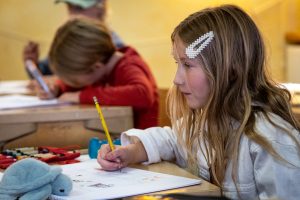
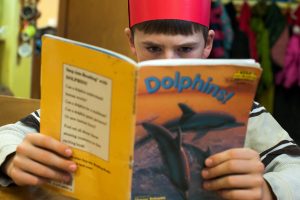
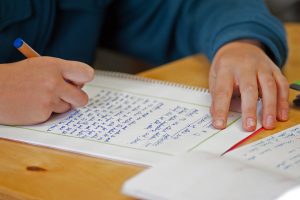
It is also at this age that we begin the shift from learning to read to reading to learn. Throughout elementary and middle school at BVWS, stories and narratives are the backbone of academic learning. Teachers weave exercises in reading and writing into lessons across every single subject area—including math!—encouraging children to read, listen to, comprehend, and recall texts in the context of the subject they are studying. If they are engaged in a class, like zoology or agriculture, students also become naturally engaged with texts about that topic, naturally cultivating their interest in reading. Reading and writing across subjects areas is further enhanced with the creation of handmade lesson books in grades 1-8, which encourage recollection and a personal connection to the class material—in addition to providing an additional opportunity to practice reading and writing every day.
Middle School: Critical Readers, Persuasive Writers
By the time they reach middle school, students at BVWS are ready to tackle more advanced concepts in language arts. With the mechanics of reading now second nature, we turn our attention to becoming more persuasive writers and critical readers over the course of 6th, 7th, and 8th grade. In composition, students learn to organize their ideas, draft essays, and edit their work, in addition to receiving and incorporating feedback from teachers and peers. In addition to expository writing, poetry and creative writing blocks help deepen their creativity, imagination, vocabulary, and personal voice, while also adding depth to our study of literature and point of view.
Continuing the rich foundations we’ve built in elementary school, reading and writing is woven into every aspect of the curriculum in middle school, including social studies, geography, math, science, and the arts. In science, for example, students record experiments, theories, and results in their main lesson books using appropriate scientific vocabulary and concepts.
By connecting literacy to learning, our programs encourage a personal connection to reading and writing, fostering lifelong readers. “Reading instruction develops technical competencies; reading formation cultivates dispositions, identities, and appetites. The former produces people who can read; the latter produces people who do read, who choose to read, who find reading rewarding enough to continue doing it when no one is watching, testing, or grading them.” writes Carl Hendrick, in the piece “In Defence of the Whole: Why Students Should Read Books Not Just Extracts.”
Additionally, reading and writing skills continue to be honed within the greater context of oral language and communication. We learn to develop ideas and point of view through lively class discussions and group work. Throughout middle school, students perform in annual class plays, sing, and recite verses. Independent and research projects almost always include an oral component in addition to written work.
By 8th grade, our students have built the skills to complete a long-term research project on a subject of their choice, which includes a written, creative, and oral component. It’s a capstone to our long journey from learning letters to expressing ourselves, and an important preparation for the more independent work they’ll do in high school.
We Don’t Rush Reading. We Do Meet Benchmarks
Many prospective families want to know why BVWS begins formal literacy “later” than mainstream schools. In many ways, the answer is simple: It is too important to rush. The ability to read, write, and communicate effectively is essential to every academic and professional discipline. Our goal is to nurture lifelong competencies and enthusiasm for the written word—without unneeded pressure. Studies consistently show that learning to write letters and sound out words in kindergarten provides no meaningful benefit to children over the long term—and may even be detrimental by causing stress to children who aren’t ready for decoding.
Just as babies learn to speak or walk at different ages, our teachers understand that children will reach literacy milestones, like decoding words, at their own individual pace. Our program allows for diversity in the classroom, while also ensuring that every student will eventually reach grade-level benchmarks in reading and writing. Class teachers, along with the educational support team, closely monitor student progress, and we intervene with extra lesson support when needed.
Finally, we know that the mechanics of reading can be taught through practice and instruction. But for building a rich and nuanced ability with language, and a lifelong enthusiasm for reading and writing, there are no shortcuts.
Do you want your child to love reading? Learn more about what we do.